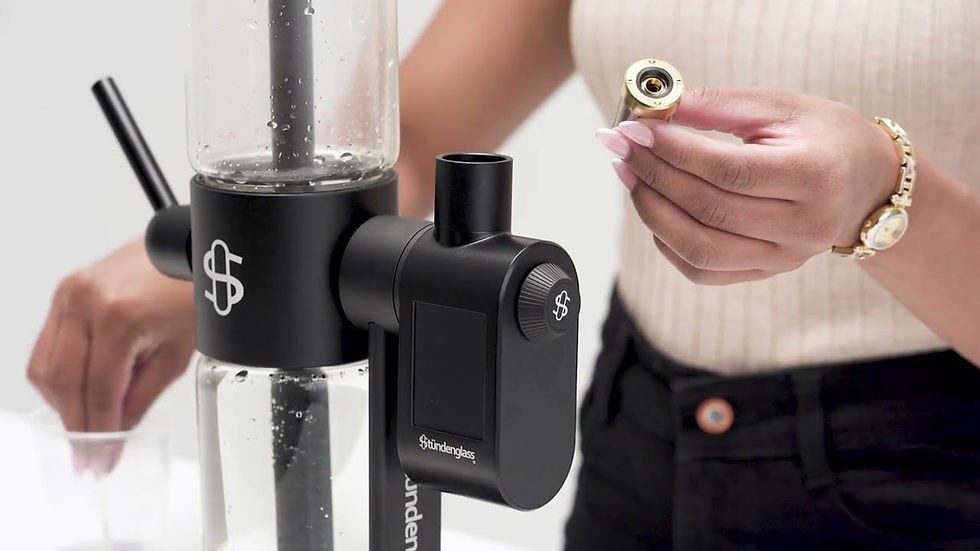
The Engineering of Inhalation: Inside Medical-Grade Hardware
In the world of high-end hardware, there is a distinct line where "gadgetry" ends and engineering begins. For the connoisseur, the experience isn't just about the ritual; it’s about the thermal dynamics, material science, and precision manufacturing that happen behind a matte-black finish.
At Hush Goods, we view these devices as precision instruments. When you move away from mass-market plastics and toward medical-grade components, you aren't just buying a tool—you’re investing in an industrial evolution.

The Foundation: Medical-Grade Materials
The most critical aspect of "Artisan Hardware" is what happens when things get hot. Standard materials can off-gas or degrade under high thermal stress. Precision engineering solves this through:
PEEK (Polyether ether ketone): A high-performance engineering thermoplastic used in medical implants and aerospace. Brands like Storz & Bickel utilize PEEK because it maintains structural integrity at extreme temperatures without impacting the flavor profile.
Borosilicate Glass: Unlike standard glass, borosilicate is engineered with boron trioxide, allowing it to handle "thermal shock"—the rapid shift from cold to hot—without cracking. It is the gold standard for purity.
Anodized Aluminum: Used for heat sinks and outer shells, anodization creates a hard, non-reactive surface that is scratch-resistant and exceptional at dissipating heat away from the electronics.
The Physics of Flavor: Convection vs. Conduction
Understanding the engineering of inhalation requires a look at how heat is transferred. This isn't just "heating up"; it's a controlled extraction.
Conduction (The Engine Block): The material makes direct contact with a heated surface. It’s efficient and fast, but it requires precision timing to ensure even heating.
Convection (The Industrial Oven): Hot air is forced through the material. This provides the most uniform extraction and is the hallmark of desktop titans like the Volcano Hybrid.
Hybrid Systems: The cutting edge of 2026 tech, seen in units like the Venty, uses a combination of both to provide "instant-on" speed with the purity of airflow-driven extraction.
Form Follows Function: The Industrial Aesthetic
There is a reason the Storz & Bickel lineup looks like it belongs in a high-end workshop rather than a jewelry box. The "ruggedized" exterior with deep cooling fins isn't just for show—those fins increase the surface area of the device, allowing heat to escape naturally through the shell.
Similarly, the Puffco Peak Pro represents the "Silicon Valley" approach to industrial design: minimalist, integrated, and software-driven. Inside, the 3D XL Chamber uses traces of gold-plated stainless steel to ensure the most consistent thermal floor in the industry.
Why Engineering Matters
When we talk about "Artisan Hardware," we are talking about transparency and repeatability. Whether you are using hardware for luxury concentrates or exploring the wellness-focused models of THC-free botanicals, the hardware is the variable that determines the outcome.
In a modern industrial world, we don't settle for "good enough." We look for the technical specs, the certifications, and the engineering that ensures every inhalation is as precise as the device that created it.
Technical Note: For those optimizing their ritual, remember that precision temperature control (down to the single degree) is the only way to target specific terpene profiles without reaching the point of combustion.
Visit us at 726 Central Ave NE to see these engineering marvels in person and feel the difference that medical-grade construction makes.